Forex Currency Pairs Explained: How to Read and Trade Them

If you've ever exchanged money before a trip abroad, you've already participated in the foreign exchange market — the largest financial market in the world. In forex trading, currencies are always traded in pairs. Understanding how those pairs work is the first step to trading the market with confidence.
This guide breaks down everything you need to know about forex currency pairs: what they are, how to read them, and how trading them actually works.
What Is a Forex Currency Pair?
A forex currency pair is a quotation of two different currencies — one priced against the other. Every time you trade forex, you're simultaneously buying one currency and selling another.
For example, when you see EUR/USD, that's the euro quoted against the US dollar. The pair tells you how much of the second currency (the US dollar) you need to buy one unit of the first currency (the euro).
Currency pairs are the foundation of forex trading. You can't trade a single currency on its own — it always has to be measured against something else.
How to Read a Currency Pair
Reading a forex pair is straightforward once you know the structure. Every pair has two components:
- Base currency — the first currency listed (e.g. EUR in EUR/USD). This is the currency you're buying or selling.
- Quote currency — the second currency listed (e.g. USD in EUR/USD). This is the currency used to price the base.
If EUR/USD is trading at 1.1050, it means 1 euro buys 1.1050 US dollars.
When you buy a currency pair, you're buying the base currency and selling the quote currency. When you sell, you're doing the opposite — selling the base and buying the quote.
Bid Price and Ask Price
Every currency pair has two prices displayed at any given moment:
- Bid price — the price at which you can sell the base currency
- Ask price — the price at which you can buy the base currency
The difference between the bid and ask is called the spread. This is effectively the cost of the trade and how most forex brokers make money.
What Is a Pip?
A pip (percentage in point) is the smallest standard price movement in a currency pair. For most pairs, a pip is a movement of 0.0001 — the fourth decimal place.
For example, if EUR/USD moves from 1.1050 to 1.1051, that's a one-pip move.
Pips matter because they're how traders measure profit and loss. A trade size of 10,000 units (a mini lot) means each pip is worth about $1. Knowing your pip value helps you manage risk before you enter any position.
Types of Forex Currency Pairs
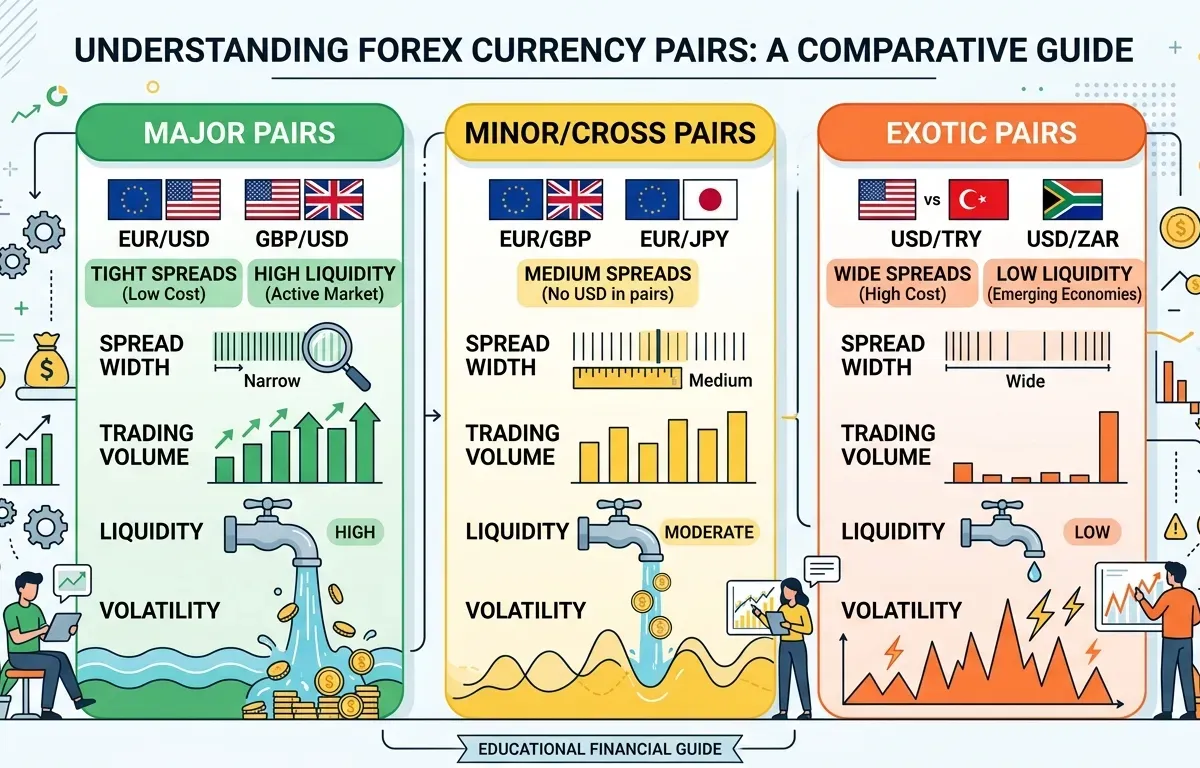
Not all currency pairs behave the same way. They're typically grouped into three categories based on trading volume and liquidity.
Major Currency Pairs
Major pairs always include the US dollar on one side. They're the most traded pairs in the world and generally have the tightest spreads, making them the most cost-effective to trade.
The most common major pairs include:
- EUR/USD — Euro / US Dollar
- GBP/USD — British Pound / US Dollar
- USD/JPY — US Dollar / Japanese Yen
- USD/CHF — US Dollar / Swiss Franc
- AUD/USD — Australian Dollar / US Dollar
- USD/CAD — US Dollar / Canadian Dollar
- NZD/USD — New Zealand Dollar / US Dollar
For beginners, major pairs are the best place to start. They're well-researched, highly liquid, and less prone to erratic price swings.
Minor Currency Pairs
Minor pairs (also called cross pairs) don't include the US dollar but involve other major currencies like the euro, pound, or yen.
Examples include:
- EUR/GBP — Euro / British Pound
- EUR/JPY — Euro / Japanese Yen
- GBP/JPY — British Pound / Japanese Yen
These pairs tend to have slightly wider spreads than majors and can be more volatile, but they still offer strong liquidity and plenty of trading opportunities.
Exotic Currency Pairs
Exotic pairs combine one major currency with a currency from an emerging or smaller economy — think the US dollar paired with the Turkish lira (USD/TRY) or the South African rand (USD/ZAR).
Exotic pairs tend to have:
- Higher spreads — the cost to trade is greater
- Lower liquidity — fewer buyers and sellers at any given moment
- Higher volatility — prices can move sharply on local news or economic shifts
They're generally not recommended for beginners, but experienced traders use them to diversify exposure or take advantage of macro trends in developing economies.
How to Trade Forex Currency Pairs
Trading forex pairs comes down to a simple idea: you're making a judgment call on which direction the exchange rate will move.
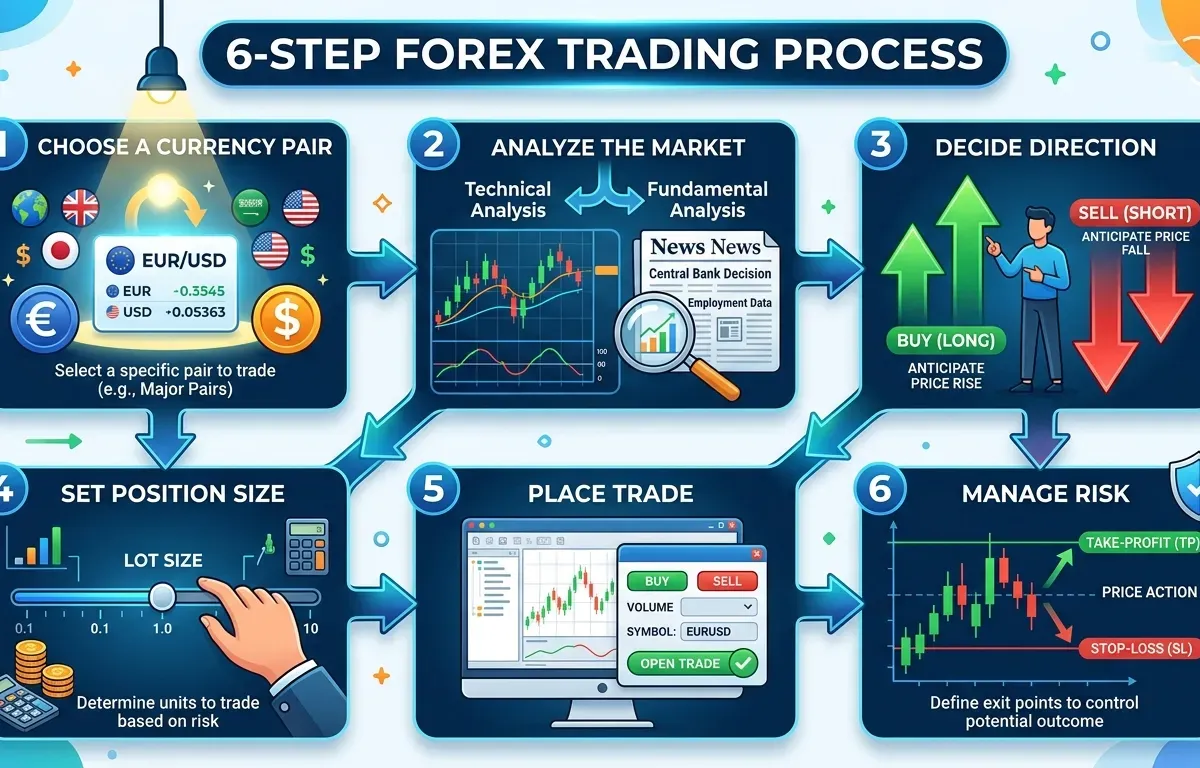
Here's the basic framework:
- Choose a currency pair — start with a major pair like EUR/USD or GBP/USD
- Analyze the market — use technical analysis (price charts, indicators) or fundamental analysis (economic data, central bank policy)
- Decide your direction — will the base currency strengthen (go long/buy) or weaken (go short/sell)?
- Set your position size — determine how many units or lots you're trading
- Place your trade — enter the market through your broker's trading platform
- Manage your risk — set a stop-loss order to cap potential losses and a take-profit level to lock in gains
Going Long vs. Going Short
- Going long means you buy the base currency, expecting it to rise against the quote currency
- Going short means you sell the base currency, expecting it to fall against the quote currency
Both directions are equally accessible in forex — unlike stocks, you can profit in either a rising or falling market.
Key Factors That Move Currency Pairs
Currency prices aren't random. They respond to a mix of economic data, central bank decisions, and global sentiment. The main drivers include:
- Interest rates — higher rates typically attract foreign capital and strengthen a currency
- Inflation data — rising inflation can push central banks to raise rates, affecting exchange rates
- Employment figures — strong job numbers signal a healthy economy and often boost a currency
- GDP growth — a growing economy tends to support a stronger currency
- Political stability — uncertainty or instability can weaken a currency quickly
- Market sentiment — risk-on and risk-off moods shift capital flows between currencies
Staying aware of economic calendars and central bank announcements gives you a meaningful edge when reading why a pair is moving.
Common Mistakes Forex Beginners Make
Getting started in forex is exciting — but a few missteps trip up nearly every new trader:
- Overleveraging — forex brokers offer high leverage, which amplifies both gains and losses. Use it carefully.
- Ignoring the spread — a wide spread on an exotic pair can eat into your profits before the market even moves in your favor.
- Trading too many pairs at once — focus on one or two pairs until you understand their behavior well.
- Skipping risk management — always set a stop-loss. No trade is a certainty.
- Chasing the market — entering a trade after a big move has already happened is a recipe for getting caught in a reversal.
Discipline and consistency matter far more than finding a "perfect" strategy.
Ready to Build Your Trading Skills?
Forex currency pairs are the building blocks of the entire foreign exchange market. Once you understand how to read a pair, what the bid-ask spread means, and how pips translate to real profit and loss, the market starts to make a lot more sense.
Start with the major pairs, keep your position sizes manageable, and always know your risk before you enter a trade. The more time you spend watching how pairs move — and why — the sharper your instincts will become.
If you're ready to put these fundamentals into practice, Conectiv offers live trading sessions and a trading community where you can learn from experienced traders and apply what you've learned in real market conditions. Visit the Conectiv membership page to explore how to get started.