The Power of Compounding Interest: How to Grow Your Wealth Over Time
What Is Compound Interest and How Does It Drive Investment Growth?
Compound interest is interest calculated on the initial principal and on interest that has been added to that principal from prior periods. In practice, this means you earn interest on interest, producing faster growth than simple interest. For example, a $1,000 investment at 5% annual interest becomes $1,050 after one year; in the second year you earn interest on $1,050, increasing your returns beyond the first year.
Compound Interest in Investment Portfolios
Effective long-term investing requires a structured strategy built on thorough analysis. The compound interest model is a core tool for estimating potential returns because it shows interest accumulating on both principal and previously earned interest. This study examines how compound interest operates within investment portfolios, clarifying its effect on long-term growth. By analysing variables such as investment duration and compounding frequency, the paper highlights the mechanisms that drive portfolio expansion. The application of compound interest in investment portfolios, 2024.
How Does Interest Compounding Frequency Affect Wealth Building?
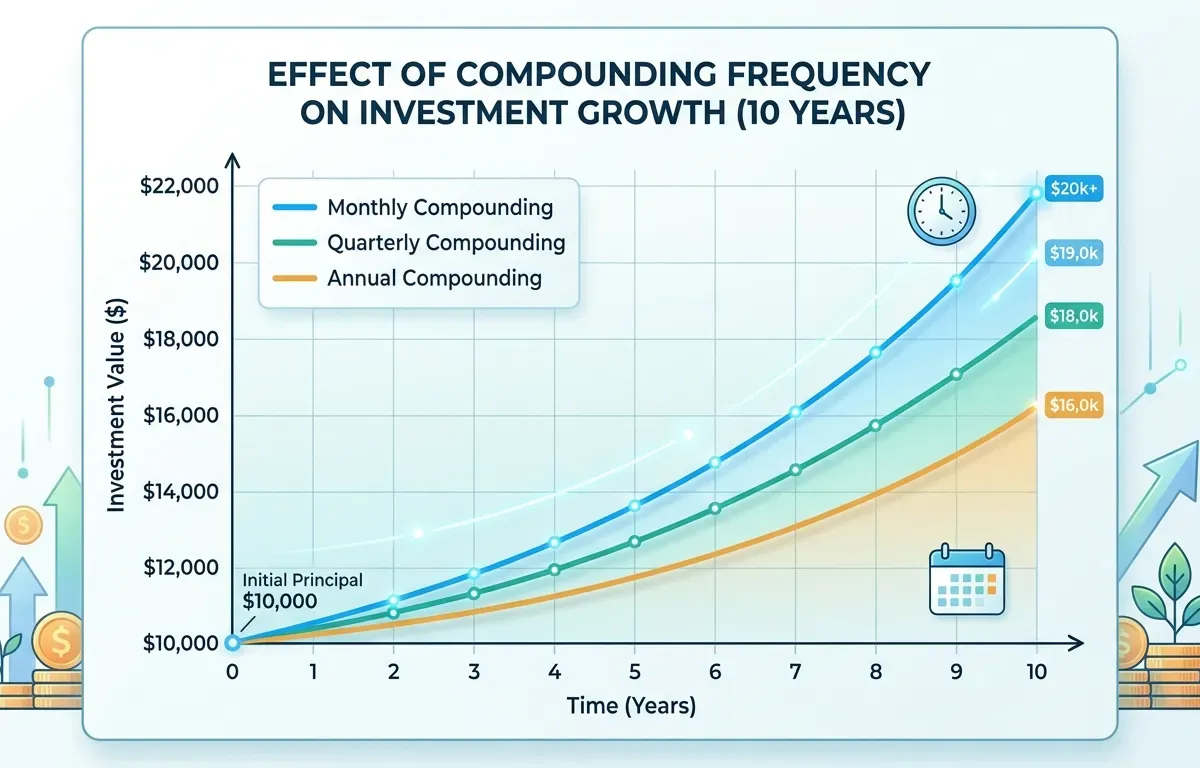
Compounding frequency changes how much interest you earn. Common options are annually, semi-annually, quarterly and monthly; more frequent compounding gives higher returns. For example, $1,000 at 5% compounded monthly becomes about $1,051.16 after one year, versus $1,050 with annual compounding. That difference shows how frequency affects wealth accumulation.
What Is the Difference Between Simple and Compound Interest?
Simple interest applies only to the principal, while compound interest applies to the principal and to interest that has been added. For example, $1,000 at 5% simple interest for two years yields $100 in interest; with compound interest, interest from year one is added to the principal and itself earns interest in year two, producing a larger total.
Understanding Compound Interest: Fundamentals and Formulations
Compound interest is the most common form used in commercial transactions. Interest accrued during one period then earns interest in the next, so capital grows faster than with simple interest. We begin by deriving the standard compound interest formula and then address situations where the interest conversion period does not match the stated nominal rate. Compound Interest, Z Lukač, 2025.
How to Use the Compound Interest Formula for Long-Term Wealth Building
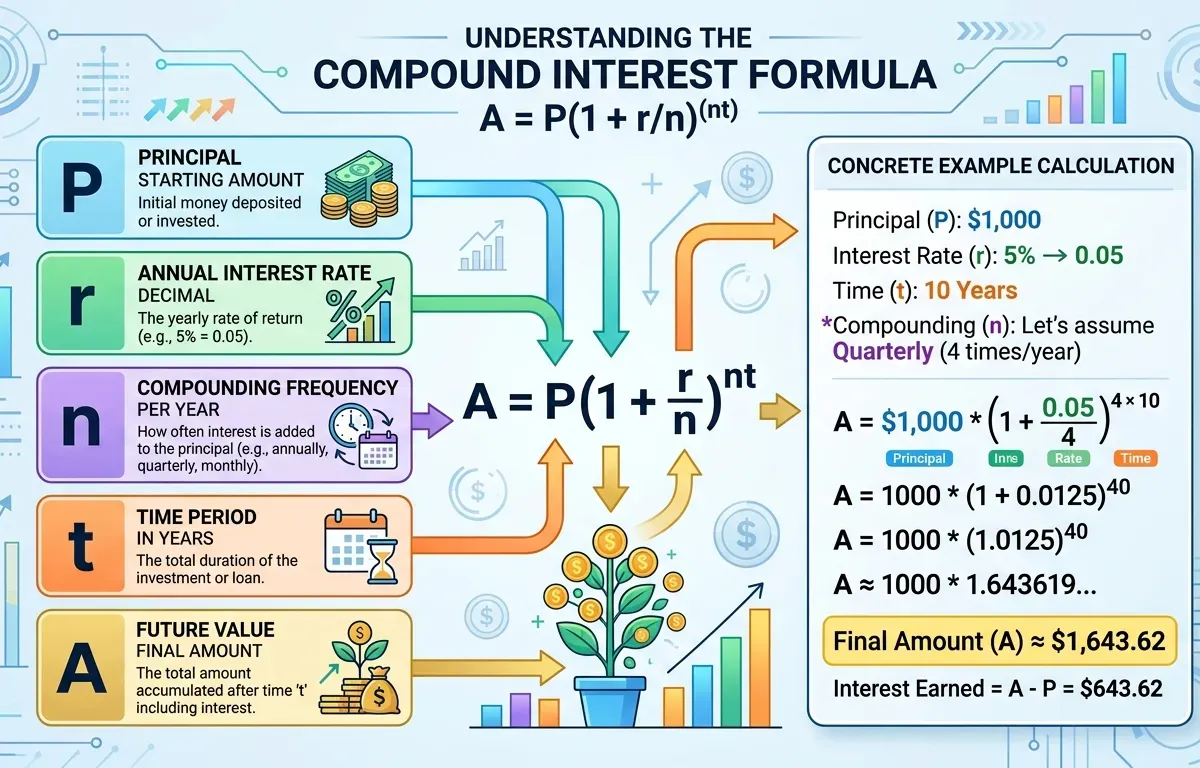
To apply compounding reliably, use the standard compound interest formula:
A = P(1 + r/n)^(nt)
Definitions:
- A = the future value of the investment/loan, including interest
- P = the principal investment amount (initial deposit or loan amount)
- r = the annual interest rate (decimal)
- n = the number of times that interest is compounded per year
- t = the number of years the money is invested or borrowed
What Are the Key Variables in the Compound Interest Formula?
The main variables are principal, interest rate, compounding frequency and investment duration. Each factor directly affects total returns: higher principal or rate increases returns, more frequent compounding raises effective yield, and a longer duration allows more periods for growth.
How Can You Calculate Investment Growth Over Time Using This Formula?
Calculate growth by inserting your values for P, r, n, and t into the formula. For example, investing $1,000 at 5% interest compounded monthly for 10 years uses:
A = 1000(1 + 0.05/12)^(12×10) ≈ $1,648.73
This yields approximately $1,648.73, illustrating how regular compounding increases the investment over time.
Elucidation of the Compound Interest Formula
The formula for capital growth under compound interest is S = (1 + i)^n. This expression is widely applicable as an approximation when the interest rate 'i' is sufficiently small, as is often the case in practical calculations. Rapid Calculation of Compound Interest Processes, 1919.
How Can Sustainable Investing Enhance Your Compound Interest Returns?
Sustainable investing balances financial returns with environmental, social and governance considerations. Integrating these factors into investment selection can support stronger long-term returns. Sustainable strategies tend to favour well-managed, forward-thinking companies that may deliver more resilient performance over time.
What Role Do Environmental, Social, and Governance Metrics Play in Portfolio Optimization?
Environmental, social and governance metrics help assess a company's sustainability and long-term resilience. Evaluating firms on these criteria helps identify those better positioned to manage regulatory shifts and changing consumer preferences, which can support improved financial performance over the long run.
How Does Incorporating Sustainability Analytics Impact Long-Term Investment Growth?
Using sustainability analytics highlights risks and opportunities that financial metrics alone may miss. Focusing on companies that prioritise sustainability can enhance portfolio resilience and growth potential. Research indicates that sustainable investments can outperform traditional strategies over extended periods, making them worth considering for compounding benefits. Whether you're exploring mutual fund options, individual stocks, or diversified portfolios, sustainability factors can play a role in your long-term wealth accumulation strategy.
What Tools and Calculators Help Track Compound Interest and Sustainable Wealth Growth?
Several online tools and calculators help investors model compound interest and track sustainable wealth growth. These resources project outcomes for different scenarios and support data-driven planning.
How Do Compound Interest Calculators Incorporate Interest Compounding Frequency?
Calculators typically let you enter principal, interest rate, compounding frequency and investment duration. Adjusting those inputs shows how frequency alters total returns, making it easier to compare scenarios and choose the most effective approach.
Where Can Investors Find Platforms Combining Financial and Sustainability Analytics?
Platforms that combine financial and sustainability analytics are offered by many financial service providers. These tools assess both financial prospects and sustainability metrics, helping investors align returns with long-term values and objectives.
Investment Type | Compounding Frequency | Total Returns After 10 Years |
|---|---|---|
Monthly | Monthly | $1,648.73 |
Quarterly | Quarterly | $1,643.62 |
Annually | Annually | $1,628.89 |
The table demonstrates how compounding frequency affects ten-year returns, underscoring the practical importance of compounding in investment planning.
Frequently Asked Questions
What are the long-term benefits of compound interest compared to simple interest?
Compound interest produces exponential growth because it applies to both principal and accumulated interest, while simple interest applies only to the principal. Over multiple years, compound interest yields substantially higher totals—for the same rate and principal—making it a more effective approach for long-term wealth accumulation.
How can investors identify high-performing companies for compound interest benefits?
Identify companies with consistent revenue growth, healthy profit margins and strong return on equity. Assess management quality and competitive position, and use screening tools to monitor candidates. Combining quantitative indicators with sector research and reputable news sources helps spot firms with solid long-term potential.
What mistakes should investors avoid when using compound interest strategies?
Common mistakes include delaying the start of investing, ignoring fees that reduce returns, and changing strategies too frequently. Maintain a long-term focus, control costs, and diversify holdings to reduce risk while allowing compound returns to accumulate.
How does inflation affect the effectiveness of compound interest?
Inflation erodes purchasing power, so if inflation outpaces your investment return, real wealth can decline. Choose investments that aim to outperform inflation to preserve and grow real value over time.
Can compound interest be applied to debt, and how does it work?
Yes. When interest on debt compounds, interest is charged on accrued interest as well as the principal, increasing the total cost to the borrower. Managing repayments and prioritising high-cost debt reduces the burden of compounding on liabilities.
What are some effective tools for tracking compound interest growth?
Useful tools include online compound interest calculators, financial planning software and personal finance apps that integrate projection and tracking features. These tools let you simulate scenarios and monitor performance to support data-driven decisions.
Start Building Your Wealth With Compound Interest Today
Understanding compound interest is the foundation of long-term wealth building. The earlier you start investing, the more time your money has to grow through compounding. Whether you're beginning your investment journey or refining an existing strategy, the principles covered in this guide apply across all investment vehicles—from savings accounts to mutual funds to diversified portfolios.
The power of compounding isn't magic; it's mathematics working in your favor. By starting early, staying consistent, and choosing investments aligned with your goals and values, you can harness this force to build meaningful wealth over time.
Ready to deepen your financial knowledge and develop a personalized investment strategy? Wire Clarity offers comprehensive financial education, live trading sessions, and community support to help you make confident investment decisions. Our programs break down complex concepts into actionable steps you can implement right away.
Get started today: Visit wireclarity.com/contact to learn more about our membership and educational programs, or call (770) 628-5463 for more information.